Your ideas are too narrow, too crippled. I am a citizen of the universe, and a gentleman to boot!
The First Doctor
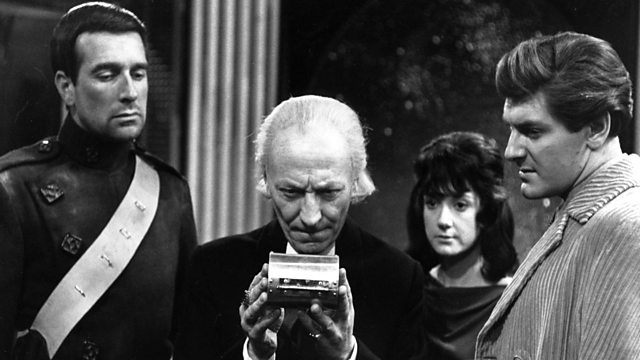
Synopsis
In the year 4000, the Daleks conspire to conquer the Solar System. Their scheme involves treachery at the highest levels and a weapon capable of destroying the very fabric of time. Only the Doctor and his friends can prevent catastrophe — and there is no guarantee they will escape with their lives…
Review
The Daleks’ Master Plan is ultimately an enjoyable mess. It starts well, picking up from where Mission to the Unknown left off, but does lose its way along the way. Thankfully, it does stick the landing in its final part.
It is undeniably a sign of the show’s ambition that a story of this kind was even attempted. The show was in a really experimental stage in its third season and The Daleks’ Master Plan is perhaps the biggest statement of that. The similar length, and arguably better, The War Games was a necessity after other stories fell through leading up to Patrick Troughton’s departure from the show, but this story perhaps shows the extent of Dalekmania in the 1960s. The start of the story really swaggers with confidence, introducing us to various characters and killing some of them off along the way and is really effective.
As we get into the latter half of the story, however, the story starts falling into the formula laid down by The Chase. We move between settings with little care for who we meet and ultimately are going to get left behind, because they are ultimately doomed. It is almost a blessed relief when the Monk turns up and the action settles down in Egypt for a little while. It is definitely relevant to say that The Daleks’ Master Plan was never intended to be a story that someone would sit down and watch in one go and certainly I can see that it would work so much better watched in weekly half-hourly installments. It also suffers from the fact that so much of it is missing and animating it would be a major endeavour. The sections that survive are compelling watching and certainly have been well-directed, as Douglas Camfield is one of the best directors to work on the show in its original run.

Oh, how I shall always remember her as one of the Daughters of the Gods. Yes, as one of the Daughters of the Gods.
The First Doctor
It is painfully obvious that Terry Nation struggles to write for Katarina, who is a character who needs a lot of items explained to her at such length that it does feel as though other characters are speaking down to her. It is perhaps, questionable about the production team’s decision to retain her as a companion, but I suppose this reflects the almost ad hoc nature in which the program was made in its infancy. Later companions from the Earth’s past, for instance, Jamie, would be written much better and the explanations, when necessary, largely work much better than they do here with Katarina. It is perhaps no surprise that Katarina is the companion to be killed off first, in a story that feels quite a lot more bloodthirsty than any other. It’s a thankless task for Adrienne Hill and it is perhaps in the best interests of both the actor and the show that the association ended here.
This story does give us two other almost companions who don’t see it to the end of the story, along with Steven, who is a constant presence throughout the story. We have Bret Vyon, played by Nicholas Courtney, and Sara Kingdom, played by Jean Marsh, who are revealed to be siblings although you probably could be forgiven for not knowing that given how coolly Sara dispatches him at the end of The Traitors. Both Courtney and Marsh put in good performances, and the story does a good job in establishing Sara as a character and establishing a bond with Steven, creating a bigger emotional punch when Sara dies at the end of the story. Despite the fact that she murders her brother, Sara does seem to be a prototypical companion. Peter Purves does a great job in this story too, and has easy rapport with Jean Marsh, helping to sell the idea of them being a companion team moving forward until the unfortunate events of the final episode.
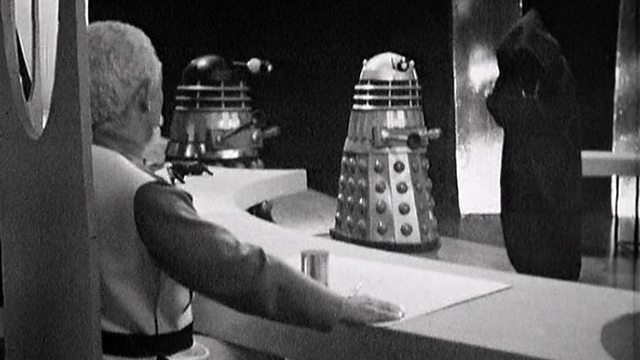
The Daleks feel like a proper threat again here, which certainly aids the story when it gets into the latter sections, chasing the TARDIS through time and certainly works better than it did in The Chase. This is down to the fact that the Daleks have a sensible reason to be chasing the Doctor. By stealing the Taranium Core, the Doctor sabotages their plans to destroy the solar system and gives the Daleks a decent motivation to catch him. They are supported through most of the story by Mavic Chen, played by Kevin Stoney. Mavic Chen is possibly one of the most memorable characters, and although Stoney is in yellowface, which is obviously problematic, it does not detract from a great performance. Chen is a duplicitous politician who would not feel out of place in the Pertwee era, presenting as someone who wants the best for humanity but in practice, wanting to be the Daleks’ right-hand man. With some experience of watching Doctor Who, people wanting to be in that position to the Daleks tend to end up exterminated, and Chen is no exception. His deterioration as he realises how non-essential he is to their plans is highlight of the latter parts of the episode.
Here’s a toast, a happy Christmas to all of you.
The same to you Doctor, Sara.
And incidentally, a happy Christmas to all of you at home.
The First Doctor and Steven Taylor
The Feast of Steven, Part 7, really doesn’t feel as though it has aged well. Intended as a romp, as the episode would broadcast on Christmas Day and they did not wish for the loyal viewers to possibly miss an installment or to potentially confuse one-off viewers. Ultimately though, the humour contained within it feels very of its time. Comedy doesn’t tend to age well, and when the show leans so heavily into it that the episode suffers. At the end of The Feast of Steven, it is perhaps easy to forget that two characters we’d spent almost a third of this story with had died horribly.
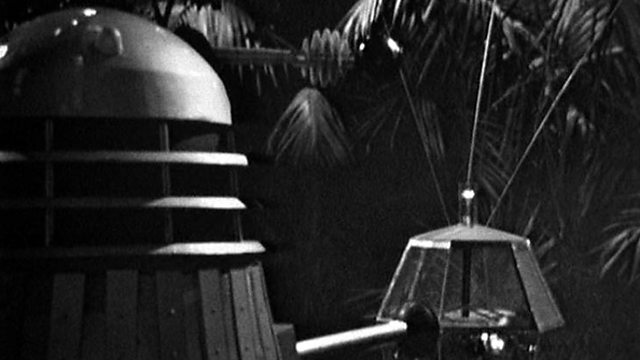
The Daleks’ Master Plan is a crucial story and demonstrates just how far William Hartnell’s Doctor has come from An Unearthly Child. It cements that the Doctor is no longer the self-interested character he once was, being willing to hand over the Tarinum core to save his friends from the Daleks, even including the Monk in his negotiations despite his fellow Time Lord’s attempted earlier betrayal. Equally, this story establishes beyond doubt that the Doctor himself is not human, as the Time Destructor doesn’t affect him in the same way it does Sara. The Doctor may escape this story with his hero status intact, but his reaction to the losses suffered certainly marks him out as being different to Steven. Whilst Steven wants to mourn those deaths, the Doctor seems to be ready to move on and keep travelling. This could at the most generous interpretation be seen to be a start to that personality trait of the Doctor that he doesn’t stop but has just kept running for fear of dealing with his grief.
Verdict: Whilst it is undoubtedly too long, The Dalek’s Master Plan is an ambitious and mostly successful story which is important in the show’s history. 8/10.
Cast: William Hartnell (The Doctor), Peter Purves (Steven Taylor), Jean Marsh (Sara Kingdom), Adrienne Hill (Katarina), Brian Cant (Kert Gantry), Nicholas Courtney (Bret Vyon), Pamela Greer (Lizan), Philip Anthony (Roald), Kevin Stoney (Mavic Chen), Michael Guest (Interviewer), Kevin Manser, Robert Jewell, Gerald Taylor and John Scott Martin (Daleks), Peter Hawkins and David Graham (Dalek Voices), Julian Sherrier (Zephon), Roy Evans (Trantis), Douglas Sheldon (Kirksen), Dallas Cavell (Bors), Geoffrey Cheshire (Garge), Maurice Browning (Karlton), Roger Avon (Daxtar), James Hall (Borkar), Bill Meilen (Froyn), John Herrington (Rhynmal), Clifford Earl (Station Sergeant), Norman Mitchell (First Policeman), Malcolm Rogers (Second Policeman), Keneth Thornett (Detective Inspector), Reg Pritchard (Man in Mackintosh), Sheila Dunn (Blossom Lefavre), Leonard Grahame (Darcy Tranton), Royston Tickner (Steinberger P. Green), Mark Ross (Ingmar Knopf), Conrad Monk (Assistant director), David James (Arab Sheik), Paula Topham (Vamp), Robert G. Jewell (Clown), Albert Barrington (Professor Webster), Buddy Windrush (Prop Man), Steve Machin (Cameraman), Terence Woodfield (Celation), Peter Butterworth (The Meddling Monk), Roger Brierly (Trevor), Bruce Wightman (Scott), Jeffrey Isaac (Khepren), Derek Ware (Tuthmos) & Walter Randall (Hyksos).
Writers: Terry Nation (Episodes 1 – 5 and 7) and Dennis Spooner (Episodes 6 and 8 – 12)
Director: Douglas Camfield
Producer: John Wiles
Composer: Tristram Cary
Parts: 12 (The Nightmare Begins, Day of Armageddon, Devil’s Planet, The Traitors, Counter Plot, Coronas of the Sun, The Feast of Steven, Volcano, Golden Death, Escape Switch, The Abandoned Planet & Destruction of Time).
Original Broadcast Dates: 13th November 1965 – 29th January 1966
Behind the Scenes
- This story had working titles of The Daleks (Part IV) and Battle of Wits.
- At the time of writing, only Episodes 2, 5 and 10 still exist in the BBC Archives. Episode 4, The Traitors, was loaned to Blue Peter to use in a piece they were making about the show’s tenth anniversary, however, it was never returned.
- As Episode 7 was due to broadcast on Christmas Day, the decision was made that it should be a comedic episode with little to do with the overall plot, assuming that viewers would either not be watching or would not want to watch the continuation of a grim Dalek tale on Christmas Day. This episode, The Feast of Steven, features a notable fourth wall break by the Doctor, wishing the viewer a happy Christmas.
- The Monk becomes the first individual antagonist to get a rematch with the Doctor.
- Katarina becomes the first companion to die whilst travelling with the Doctor. Sara Kingdom becomes the second during the course of this story. They would be last companion deaths until Adric’s death in Earthshock.
- When Terry Nation wrote the serial, he was working on the assumption that Vicki would still be a main cast member. If this had been the case, Vicki would have been killed in The Traitors.
- There was never any plan for Katarina to be a permanent companion, with the production team regarding it as too much of a burden to have to explain everything to a companion from the past. The first scene shot by Adrienne Hill was her death scene.
- There were plans for Sara to be made into a companion, something that Jean Marsh was unaware of but was unwilling to commit to a series.
- The soon-to-be regular composer, Dudley Simpson, did not work on this serial due to a dispute with the director, Douglas Camfield. This originated from a falling out the pair had after the production of The Crusade. On the next serial Camfield directed, he elected to use percussion music, which Simpson interpreted as a snub, and escalated tensions between both men. By the time that The Daleks’ Master Plan went into production, tensions were so severe that Simpson was not even considered and Camfield hired Tristram Cary instead. The dispute was not resolved before Camfield’s death in 1984.
- In further relationship problems, William Hartnell and producer John Wiles were also not getting on. This was partially due to Hartnell’s health continuing to deteriorate and the producer becoming increasingly frustrated by Hartnell’s tendency to deviate from his scripted lines. Wiles also had to deal with Hartnell feuding with his dresser, something that led to a brief crew strike. The Manchester Evening News reported that Hartnell would be leaving the show, although this ultimately did not transpire.
- The Daleks’ Master Plan and Mission to the Unknown are the only two 1960s Doctor Who stories offered for overseas sale but never purchased.
- Episode 10, Escape Switch, is the 100th episode of Doctor Who.
- Peter Purves was less than pleased with the story, declaring that it was “tosh”.
Cast Notes
- Jean Marsh had played Joanna in The Crusade and would go on to play Morgaine in Battlefield.
- Brian Cant would go on to play Tensa in The Dominators.
- Nicholas Courtney would go on to play the Brigadier, starting in The Web of Fear.
- Kevin Stoney would go on to play Tobias Vaughn in The Invasion and Tyrum in Revenge of the Cybermen.
- Michael Guest had played a Mongol bandit in Marco Polo and a Saxon hunter in The Time Meddler.
- Roy Evans would go on to play Bert Pritchard in the Third Doctor story The Green Death and Rima in The Monster of Peladon.
- Geoffrey Cheshire had previously played a Viking leader in The Time Meddler and would go on to play Tracy in The Invasion.
- Roger Avon had previously as Saphadin in The Crusade.
- James Hall had previously played a soldier in The Reign of Terror.
- John Herrington would go on to play Jim Holden in Colony in Space.
- Clifford Earl would go on play Major Branwell in The Invasion.
- Malcolm Rogers had previously appeared as Dracula in The Chase.
- Reg Pritchard has previously appeared as Ben Daheer in The Crusade.
- Sheila Dunn would go on to play a computer voice in The Invasion and Petra Williams in Inferno.
- Royston Tickner would go on to play Robbins in The Sea Devils.
- Robert G Jewell was a Dalek operator.
- Terence Woodfield played Maharis in The Ark.
- Roger Brierley would go on to play Drathro in The Mysterious Planet.
- Bruce Wightman had previously appeared in The Crusade and Terror of the Zygons.
- Derek Ware appeared in The Crusade, The Smugglers, The Ambassadors of Death, Inferno and The Claws of Axos. He was a fight arranger on several stories, and set up the stunt group HAVOC.
- Walter Randall appeared in The Aztecs, The Crusade, The Invasion, Inferno and Planet of the Spiders.
Best Moment
I think that Sara’s death sequence in Episode 12 is undoubtedly the most shocking moment of this story and the one sequence that I wish more than any other survived from this story.
Best Quote
What about Bret? Katarina? …Sara?
What a waste. What a terrible waste.
Steven Taylor and the First Doctor
Previous First Doctor review: The Myth Makers
For more First Doctor reviews, click here.

 The Impossible Blog
One thought on “The Daleks’ Master Plan”