Well…it is a fact, Jamie, that I do tend to get involved.
The Second Doctor
Synopsis
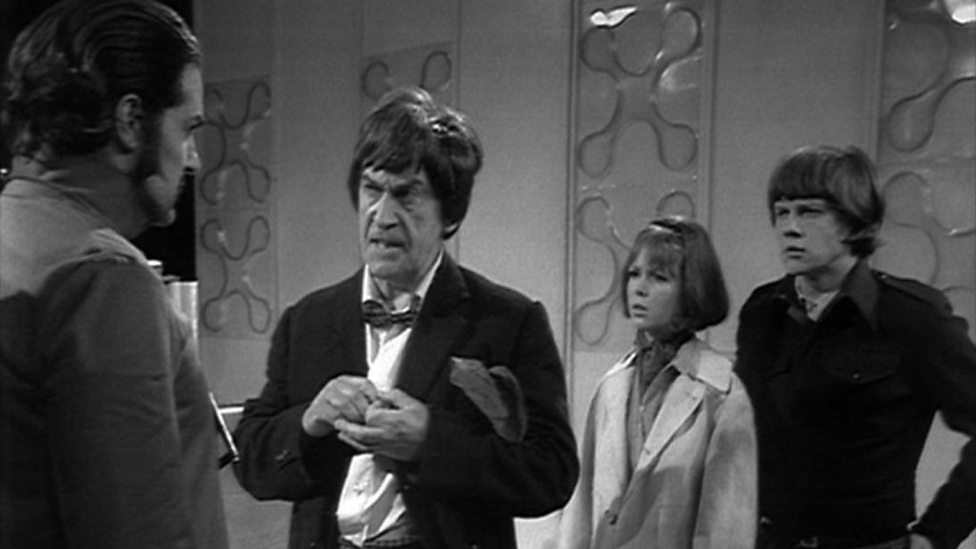
The TARDIS takes the Doctor, Jamie and Zoe to the battlefields of World War I but once they are captured it starts to become clear that things aren’t quite what they seem.
Review
The War Games is a crucial point in the history of Doctor Who. With declining figures, an exhausted lead and the two supporting cast also on their way out of the door, the finale of Season 6 could very easily have been the end of Doctor Who. The 1960s saw the show at one of its most experimental periods, but just under a month after Episode 10 broadcast, the United States put a man on the Moon, and a few months later, John Lennon would leave the Beatles, bookending the 1960s. The World was changing, and Doctor Who had to adapt to survive. Given the chaotic situation around it’s inception, The War Games has absolutely no right to be one of the highlights, not only of 1960s Doctor Who, but Doctor Who more generally.
Whilst there is the obvious issue that this story is ten parts long, I never found it to outstay its welcome. Whilst there are repeated elements such as the Doctor and his companions repeatedly being captured, especially in the first few parts, these serve to heighten the mystery as the Doctor and his companions learn about their new surroundings, the hypnotic powers of characters like Smythe and Von Weich and why the inhabitants of the zones have difficulties retaining their memories. The story feels incredibly coherent, despite its length and it does not fall into the same traps as The Daleks’ Master Plan, which feels as though it wants to be a different story about halfway through. It is also true that there are some very stereotypical depictions of some of the troops, especially the Mexicans, and the American Civil War sequences feature a group of very British actors trying to do American accents. There are some compelling characters in this story though, most notably Lady Jennifer and Carstairs who have a fledgling relationship.
The story has to establish a threat which is too great for the Doctor to defeat on his own, and the story effectively uses its extended running time to reveal further layers in the plot, from Smythe up to the War Lord. As the War Lord, the main antagonist, does not appear until relatively late in the story, the Doctor has to deal with some formidable foes on his way to facing off against this story’s main adversary, and further along the story, has to deal with the War Chief and Security Chief’s attempts to curry favour with the War Lord. Now would be an appropriate moment to mention that the War Chief is the first member of the Doctor’s race we have met since the Monk and is using Time Lord technology to assist the cause. There is speculation that this could be the Master, but I don’t necessarily think that this is the case and there is little reason for this not to be another renegade Time Lord. The War Lord is played by Philip Madoc, who brings a superbly otherworldly energy to the character and he feels both effectively powerful and creepy.
You have returned to us, Doctor. Your travels are over.
Time Lord
The Second Doctor is perhaps the incarnation of the Doctor who feels most like he has run away from home, and at the end of Episode 9, the Doctor is forced into calling his own people to solve the problems caused by the War Lords. Troughton’s acting in this scene adds to the feeling of dread, combined with the moments when they slow down time to stop the Doctor and his companions from running away. The arrival of the Time Lords into the story almost feels as though they are parents arriving at a house party and are here to almost stop the fun. The Second Doctor tries desperately to get away three times, but the power of his own people is so great that this is completely fruitless. Without raising their voices or doing anything so gauche as raising a gun, the Time Lords are utterly terrifying and a true force of nature in this story. You can see why some might struggle reconciling the Time Lords introduced here and seen through the Jon Pertwee era with those who appear later on in the original run of the show from The Deadly Assassin. However, it is clear to see why this restrictive society is one that the Doctor would want to run away from and how it could easily stagnate, which Time Lord society could be said to have done by the time Robert Holmes’ story comes around.
I thought I’d forgotten something important, but it’s nothing.
Zoe
The Doctor’s companions prove their loyalty and commitment to the Doctor throughout the story, but especially in the closing episodes. Jamie and Zoe stick by the Doctor in every decision he makes, and continue to have faith in him to get them out of the sticky situation in which they find themselves even when the situation is hopeless. The tragedy of their situation as they end up with all of their memories of almost their entire travels with the Doctor erased. Whilst this is bad enough for Zoe, confused on her return to the Wheel as her memories fade, Jamie is thrust back into another battle and considering the amount of time the character spent on the show, all of his character’s development has been lost. Of course, we have subsequently had stories set in Season 6B which see the Second Doctor and an older Jamie reunited.
In his final story, Patrick Troughton continues to shine as the Doctor and it is lovely to be able to see his final story in his entirety and enjoy his performance in fully. Troughton captures all of the facets needed from his Doctor in this story ranging from his faux outrage as he pretends to be an officer in the British Army in the World War One Zone to his quiet resignation as the Time Lords finally catch up with him. His scenes in the trial and leading up to his regeneration are powerful stuff and makes the lack of actual regeneration seem like less of a problem.
Verdict:The War Gamesbrings the Second Doctor’s era to a close with a bang. 10/10
Cast: Patrick Troughton (The Doctor), Frazer Hines (Jamie McCrimmon), Wendy Padbury (Zoe), Jane Sherwin (Lady Jennifer), John Livesey (German Soldier), David Savile (Carstairs), Terence Bayler (Major Barrington), Brian Forster (Sergeant Willis), Noel Coleman (General Smythe), Hubert Rees (Captain Ransom), Esmond Webb (Sgt. Major Burns), Tony McEwan (Redcoat), Richard Steele (Commandant Gorton), Peter Stanton (Military Chauffeur), Pat Gorman (Military Policeman), David Valla (Lieut. Crane), Bernard Davies (German Soldier), Gregg Palmer (Lieut. Lucke), David Garfield (von Weich), Edward Brayshaw (War Chief), Bill Hutchinson (Sgt. Thompson), Terry Adams (Corporal Riley), Leslie Schofield (Leroy), Vernon Dobtcheff (Scientist), Rudolph Walker (Harper), John Atterbury (Alien Guard), Michael Lynch (Spencer), Graham Weston (Russell), James Bree (Security Chief), Charles Pemberton (Alien Technician), David Troughton (Moor), Philip Madoc (War Lord), Peter Craze (Du Pont), Michael Napier-Brown (Arturo Villar), Stephen Hubay (Petrov), Bernard Horsfall (First Time Lord), Trevor Martin (Second Time Lord), Clyde Pollitt (Third Time Lord) & Clare Jenkins (Tanya).
Writers: Terrance Dicks and Malcolm Hulke
Director: David Maloney
Producer: Derrick Sherwin
Composer: Dudley Simpson
Parts: 10
Original Broadcast Dates: 19th April – 21 June 1969
Behind the Scenes
This story is notable for introducing the Time Lords and depicting the Doctor’s home planet for the first time.
Excluding counting The Trial of a Time Lord as a continuous story, this is the longest story time survive the purging of the BBC’s videotape archive. Therefore, it is at the time of writing, the earliest point in the series to start watching and avoid missing episodes.
The departure of Troughton, Hines and Padbury made this the first time either a companion or Doctor departed in the concluding episode of a season. It is also the first time that an incarnation of the Doctor and all their companions were written out of the program in the same story.
Unlike most regeneration stories, the change of lead actor was not depicted on screen. This is the first and only time in the show’s history that this has happened and gave rise to the fan theory of Season 6B.
None of the four faces proposed to the Second Doctor for their next appearance resemble Jon Pertwee. Pertwee had, in fact, not been cast at the time of filming the exile scene.
In the novelisation, the SIDRAT is revealed to stand for Space and Inter-time Directional Robot All-purpose Transporter.
This is the only story to feature actor Philip Madoc not to be written by Robert Holmes.
Even though it can be considered not to be complete, this is the longest regeneration story. It is also the only Doctor Who story to extend beyond seven episodes not to be directed by Douglas Camfield.
Director David Maloney suggested the sequence in which the Doctor sends his plea to the Time Lords in a small box. He also suggested war settings that would be interesting to the viewers based on advice from his young son.
Terrance Dicks states that there was supposed to be a four-part story and a six-part story to close out Season 6. However, both of these projects collapsed, and producer Derrick Sherwin asked Dicks to write a ten-part finale. Dicks knew that he was not experienced enough to do this by himself and so asked Malcolm Hulke to write it with him.
This story has been ranked as Doctor Who Magazine’s favourite Second Doctor story in the 2014 and 2023 polls.
Cast Notes
David Savile would go on to appear as Winser in The Claws of Axos and Colonel Crichton in The Five Doctors.
Terence Bayler previously appeared in The Ark playing Yendom.
Hubert Rees had previously appeared as the Chief Engineer in Fury of the Deep and would go on to appear as John Stevenson in The Seeds of Doom.
Tony McEwan played Baldwin in Planet of Evil.
Richard Steele would go on to play Sergeant Hart in Doctor Who and the Silurians and a Guard in The Mark of the Rani.
Pat Gorman played 73 roles in Doctor Who, across credited and uncredited roles.
Gregg Palmer played Gern and Shav in The Tenth Planet.
David Garfield went on to play Neeva in The Face of Evil, as well as voicing Professor Stream in the Big Finish audio story The Hollows of Time.
Edward Brayshaw had previously appeared in The Reign of Terror as Léon Colbert.
Leslie Schofield would go on to appear as Calib in The Face of Evil.
Vernon Dobtcheff would go on to appear in the Big Finish audio plays The Cradle of the Snake and The Children of Seth opposite Peter Davison.
John Atterbury had previously played the White Robot in The Mind Robber.
Michael Lynch played a Thal politician in Genesis of the Daleks.
Graham Weston played De Haan in Planet of Evil.
James Bree went on to appear in Full Circle as Nefred and The Ultimate Foe as the Keeper of the Matrix.
Charles Pemberton had previously played a Cyberman in The Tomb of the Cybermen. He would go on to appear in Three’s A Crowd as Butler.
David Troughton would go on to play Peladon in The Curse of Peladon and reprise this role for Big Finish. He also played Professor Hobbs in the Tenth Doctor story Midnight.
Philip Madoc had previously played Eelek in The Krotons. He would go on to play Solon in The Brain of Morbius and Fenner in The Power of Kroll. He also played Victor Schaeffer in the Big Finish story Master.
Peter Craze played Dako in The Space Museum and Costa in Nightmare of Eden. He was the brother of Michael Craze, who played First and Second Doctor companion, Ben.
Bernard Horsfall had played Lemuel Gulliver in The Mind Robber. He would go on to play Taron in Planet of the Daleks and Chancellor Goth in The Deadly Assassin, as well as playing Arnold Baynes in the Big Finish play Davros.
Trevor Martin played an alternate Fourth Doctor in the stage play Doctor Who and the Seven Keys to Doomsday, a role that he reprised for Big Finish.
Clyde Pollitt would reprise his role in The Three Doctors.
Clare Jenkins reprises her role of Tanya from The Wheel in Space.
Best Moment
I think it has to be the moment where the Doctor realises that he has no choice but to call the Time Lords.
Best Quote
I not only admit to them, I am proud of them. While you have been content to merely observe the evil in the galaxy, I have been fighting against it.



 The Impossible Blog
2 thoughts on “The War Games”