And if anyone happens to ask whether I made any material difference to the welfare of this planet, you can tell them I came and went like a summer cloud.
The Fifth Doctor
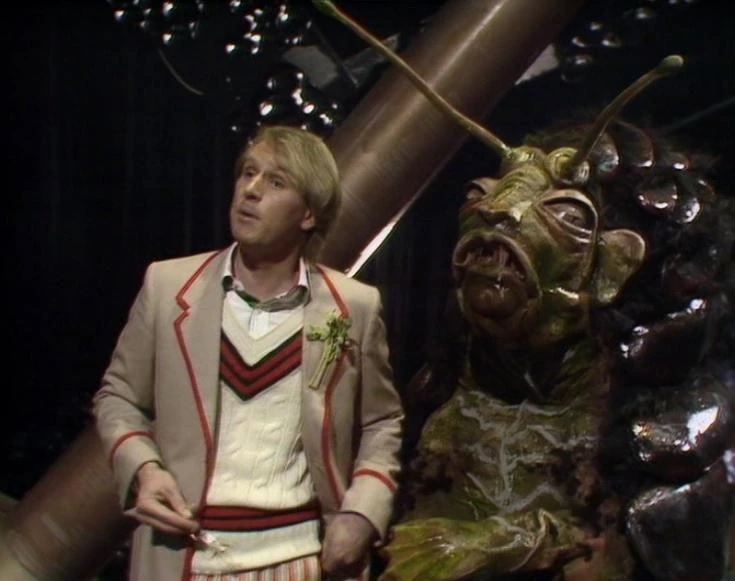
Synopsis
The Doctor, Tegan and Turlough arrive on one of the last human colonies on Frontios, where the colonists appear to be besieged by meteoroid storms. But the real threat is actually below their feet…
Review
I wasn’t sure about what to expect from Frontios. Given my track record with Season 21, I think that it’s justified, but I was pleasantly surprised by this story.
Frontios buries its own dead. That’s what they say, isn’t it?
Range
What I really like about Frontios is that it shows that to tell a dark and gritty story, you don’t have to simply kill off all your guest cast. One of my frustrations with the Eric Saward era is that it seems to equate violence with sophistication and maturity, and here his predecessor as script editor utterly shows him up. What results is a story which is entertaining to watch, which is something that I’m not sure I thought I’d ever say about a story in Season 21, and the Gravis and the Tractators manage to be terrifying, not by murdering everyone, but instead by showing that there are fates worse than death, and the way that the Tractators use the body of the Captain and have presumably used bodies and minds of countless others before we join the story is truly horrific. It’s safe to say that Bidmead takes a lot of swings here by destroying the TARDIS at the end of the first part in one of the story’s most memorable moments, but this leads to some lovely imagery as parts of the TARDIS are embedded into the walls of the caves. The design work here is really quite impressive and does not betray a lack of budget on first watch, although it can be seen that the sets are a bit wobbly or flimsier than they ought to be when you look closer. Ultimately, I think this is Ron Jones’ strongest story as director, which might sound as though I am damning him with faint praise as I’m not keen on his other work, but he does a good job with Frontios.
I do think that the Tractators are a bit of a disappointment. Bidmead describes his inspiration being woodlice and had images of the Tractators being able to curl up into balls, however, the costumes as realised did not allow for this level of movement. I think the idea and concept behind them is fine, but the lack of movement given by the costumes really lets the execution down.

Turlough gets a whole new lease of life in this story and all too late gets a bit to do, which must have been utterly thrilling for Mark Strickson. We get to see more of his character than we have done in any story previously, with the exception of the Black Guardian trilogy, which he comes out of looking a bit weasely. We learn what happened to his home planet, and the fact that he has met the Tractators before, which puts him in the unique position of knowing more about them than the Doctor. We see Turlough properly terrified in this story, which makes a nice change to how he is usually, and tapping into ancestral memory, which helps sell the threat the Tractators pose. It’s not all serious though – Strickson has a nice moment right at the start of the story where he mocks Tegan about the fate of humanity.
I got this one cheap because the walk’s not quite right. And then there’s the accent…
The Fifth Doctor
Speaking of Tegan, she is perhaps the one of our main trio who has the least to do, but at least Frontios splits the Doctor and companion team up for sections of the narrative which means that nobody really feels like a spare part in the story or is simply trailing in the Doctor’s wake. Tegan has some fun moments too, but these are mostly when the Doctor is chiding her, or stating that she is a robot to the Gravis. Perhaps it’s not a surprise that she leaves in the next story!
Another aspect of this story that works really well is the guest cast, and for that I have to give a lot of credit to the director Ron Jones. This production was beset by tragedy but you would not be able to tell that by watching the story. The standout is possibly Jeff Rawle, who is an actor who I’ve come across in a few Big Finish stories and from watching Drop the Dead Donkey, but he brings a nervous energy combined with authority to the part of Plantagenet. You get the impression that he is trying to convey more confidence and power than he actually has and Rawle seems to be tapping into almost Shakespearean territory at points. There are little nods, like nervous twitches when he is speaking that betray him. There’s no real weak performances in this guest cast, which is impressive considering William Lucas joined the cast late. It’s interesting that both Peter Davison and Mark Strickson label Peter Gilmore as standing out as someone who didn’t really get it, as I interpreted the character of Brazen as being one of those stick-in-the-mud military characters that we get so often in Doctor Who, who will ultimately give up their lives to help people escape.

Not a word to the Time Lords.
The Fifth Doctor
Frontios shows a completely different side of the Fifth Doctor to the one that we have had for the last three seasons. There is certainly something substantially different about him and he seems more explicitly like the Doctor than he does in other stories. There are moments in this when he seems to be embodying some of his predecessors, most notably perhaps Tom Baker and Patrick Troughton. Davison seems professorial, aided by his half-moon glasses, and seems to relish the script giving him the chance to do something a bit different, almost jumping at the chance to flex his muscles. Rather disappointingly, Eric Saward seems to indicate in the behind-the-scenes documentary on the DVD that he never really considered writing Davison’s Doctor in a similar vein previously. I am a fan of Peter Davison’s Doctor but I know that some of his critics think that he tends to almost fade into the background surrounded by companions, but having a Doctor more like this one would probably change a lot of opinions on him. In Frontios, Davison is truly captivating. He’s playful, charming, cheeky and a whole lot of fun. He’s afraid of the repercussions if he interferes with this group of colonists and concerned that the Time Lords will learn that he has interfered.
Verdict: Frontios was a nice surprise, a horrifying story which was actually quite entertaining to watch. Good writing and strong performances from all the cast help this be an unsung hero of Peter Davison’s last season as the Doctor. 8/10
Cast: Peter Davison (The Doctor), Janet Fielding (Tegan Jovanka), Mark Strickson (Turlough), Peter Gilmore (Brazen), Lesley Dunlop (Norna), William Lucas (Range), Jeff Rawle (Plantagenet), Maurice O’Connell (Cockerill), Richard Ashley (Orderly), John Gillett (Gravis), William Bowen, George Campbell, Hedi Khursandi, Michael Malcolm and Stephen Speed (Tractators), Alison Skilbeck (Deputy) & Raymond Murtagh (Retrograde).
Writer: Christopher H Bidmead
Director: Ron Jones
Producer: John Nathan-Turner
Composer: Paddy Kingsland
Parts: 4
Original Broadcast Dates: 26th January – 3 February 1984
Behind the Scenes
- This story had the working title of The Wanderers.
- The Tractators’ costumes were too constricting to allow for the full range of movement that the script called for. The actors inside the costumes also required air to be pumped into their costumes during breaks in filming.
- Rumours were put about that, following the TARDIS’s destruction in this story, that the ship would not be returning.
- Barrie Dobbins was the original production designer on this story, however, due to concerns about his mental health, was removed from the project. He committed suicide one year later.
- Both Peter Davison and Mark Strickson have spoken favourably about this story, however, Davison has criticised the pacing.
- The last contribution to the television show by former script editor Christopher H. Bidmead. He was invited back to write a further story featuring the Tractators, The Hollows of Time, which was never made for television, but adapted by Big Finish.
- This story is the last of the Fifth Doctor era to feature the same TARDIS team at the end as at the start. Tegan would leave at the end of Resurrection of the Daleks, Turlough would leave and Peri join in Planet of Fire and Davison would leave at the end of Caves of Androzani.
Cast Notes
- The actor Peter Arne was cast in the role of Range, however, he was murdered shortly after his costume fitting, requiring the hasty casting of William Lucas.
- Lesley Dunlop would go on to play Susan Q in The Happiness Patrol.
- Jeff Rawle has appeared in the Big Finish stories The Tyrants of Logic and Here Lies Drax. He also played Mervyn Pinfield in An Adventure in Time and Space.
Best Moment
I think that there’s no contention – it has to be the cliffhanger at the end of Part One, where the Doctor and his companions realise that the TARDIS has been destroyed.
Best Quote
Oh, marvelous. You’re going to kill me. What a finely tuned response to the situation.
The Fifth Doctor
Previous Fifth Doctor review: Nightmare Country
Previous Fifth Doctor television review: The Awakening
For more Fifth Doctor reviews, click here.

 The Impossible Blog
“One of my frustrations with the Eric Saward era is that it seems to equate violence with sophistication and maturity.”
You’ve succinctly summed up my feelings on this whole era with that one line. The Eric Saward era of Doctor Who is my least favourite to date, with only a couple of standouts, though it does make me chuckle that this and The Caves of Androzani are some of the best of the era and both are written by previous script editors.
I do wonder, if this episode had been written for earlier in Davison’s run would it have changed Saward’s entire approach to writing the Doctor? Then again it’s my personal opinion that Saward never really understood Doctor Who is the first place.
LikeLiked by 1 person
I think that Saward feels like a writer promoted beyond his station. Earthshock is really good, but I don’t think it justifies him being script editor for the rest of the era. Season 21, and especially Warriors of the Deep, is just nasty. Then you’ve got Season 22, which is mostly not good and quite nasty.
I think Saward doesn’t understand Doctor Who, or the Doctor. He openly admits in the behind the scenes bit on the DVD that he doesn’t ‘get sci-fi’ but when he is asked about how Bidmead writes the Fifth Doctor here, he seems not to ever really have considered writing the character in a different way. That’s something that Davison can weather for the most part, but when he loses interest in the Doctor when Colin Baker takes over, the character (and show) really suffer.
I hadn’t put two and two together about Frontios and Caves – but then again, this was my first time watching Frontios, so didn’t want to make assumptions about it’s quality!
LikeLiked by 1 person