There is evil in all of us, Doctor – even you. The Valeyard is an amalgamation of the darker sides of your nature, somewhere between your twelfth and final incarnations, and I may say that you do not improve with age.
The Master
Synopsis
The Valeyard’s true identity is revealed and the trial aborted, but the Doctor and Mel must pursue his new enemy into the Matrix itself, where nothing is quite what is seems…
Review
The Ultimate Foe feels as though the chaos going on behind the screen has finally bled through onto the screen. Certainly in the modern series, it is often when an arc reaches its culmination that the flaws are laid bare, and I think that is certainly true of The Ultimate Foe.
It is perhaps unfair to place the blame for this entirely at the door of this story, as that would be to ignore the fact that Trial of a Time Lord has a profoundly weak central premise and the most of the interesting parts of the story happen outside of the court room, which completely kill the pace of the story as intervals for the Doctor and the Valeyard to trade barbs degenerate into the Doctor essentially calling the Valeyard frankly ridiculous and tiresome variations on his name, whilst the Inquisitor watches on. These scenes are only made tolerable through the performances of Colin Baker, Michael Jayston and Lynda Bellingham, who frankly deserve better. I understand that the show was in crisis, but mirroring the situation the show found itself in the outside world limits its horizons, and perhaps a season of seven two-part stories would have been a more effective way of ensuring the show’s short-term survival. Certainly some of the Lost Stories produced by Big Finish show that good ideas were knocking around the Doctor Who production offices before the hiatus. There would even be the option to introduce Mel, who has an interesting and unique concept behind her and perhaps even explore her character a little bit more, rather than have her come across as overly earnest as she does here, and by her own admission, a little bit dull.

It almost seems as though there are too many elements pulling in different directions, and given that the production team knew that they were essentially being given this chance by the BBC to save the show, it feels as though key players weren’t singing from the same hymn sheet. I have been vocal in my criticism of Eric Saward, and of course his departure from the show means that this story does not reach the originally intended climax, but it feels as though other members of production ought to have been clued into where this story arc was going. There are too many inconsistencies, like Mindwarp, where it feels as though nobody has a handle on what is going on and everyone is just hoping for the best. Whilst it is perhaps highly egregious to place the blame on Saward for the passing of Robert Holmes, it was perhaps misguided for him to put the final story in his hands knowing that he was not in the best of health at the time. Holmes was an undoubtedly great writer and script editor for Doctor Who, so I can certainly see the appeal, but Saward’s reverence for him sometimes borders on the absurd, especially as his powers were certainly waning at this stage. The Two Doctors is a solid, if unexceptional story, and The Mysterious Planet is equally unremarkable. It would have been intriguing to see what would have happened if John Nathan-Turner had been bold enough to have approve the original proposed ending of the Doctor and the Valeyard falling, Holmes and Moriarty-like, into the Matrix.
It’s intriguing to think of that parallel, as I try to write more specifically about The Ultimate Foe rather than The Trial of a Time Lord more generally, considering that the Master, originally devised as the Moriarty to Jon Pertwee’s Sherlock Holmes, also features in this story. Anthony Ainley’s Master has infiltrated the Matrix and plans to bring down the civilisation of Gallifrey in this story, and knows the truth of the Valeyard. The story isn’t really sure whether it wants to depict the Master as being competent or not, and part of that is down to the difference in how Robert Holmes and Pip and Jane Baker want to portray the character. Holmes portrays him as being in the heart of the Matrix, whilst the Bakers want to make it seem like this is no mean feat, with characters able to pop in and out of the revolving door of the Matrix through an apparent revolving door. The Master is dispatched in a rather simple and reductive fashion, and perhaps even more insultingly, isn’t even recognised by those who put the Doctor on trial. This is a hard pill to swallow as it would have been in recent memory for the viewers that the High Council sent the Master into the Death Zone to rescue the Doctor, and the audience might have been able to remember the events of The Deadly Assassin or Terror of the Autons, where the Time Lords are more than aware of the renegade.
Perhaps the treatment of the Master is due to this concluding part not really being sure who the Valeyard is, or perhaps more accurately, how to bring him to screen and feel distinct from the Master. If the Master was devised as the mirror image of the Doctor, the Valeyard being an manifestation of all the darkness contained within the Doctor isn’t quite distinct enough, and it does not not help that Pip and Jane Baker have no idea what that really means. Michael Jayston does a good job with the character, and is suitably spooky and menacing, but the lack of clear answers about where he comes from in the first place really sets him up to fail. It is perhaps notable that the revived series, beyond a throwaway reference to the character in The Name of the Doctor, have not attempted to return to this element of lore.
Carrot juice, carrot juice, carrot juice…
The Sixth Doctor
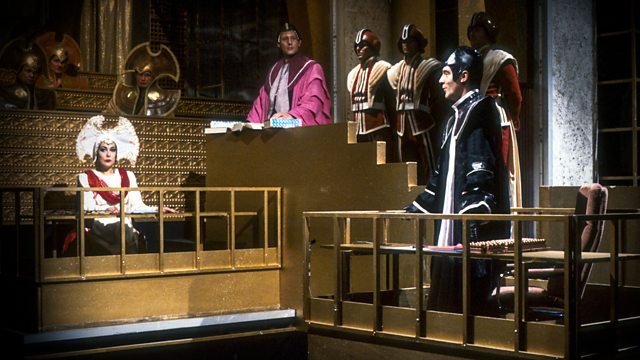
In the midst of all this onscreen and offscreen chaos sits our hero, the Doctor, our calm in the storm, and it is fair to say that Colin Baker delivers everything that he is asked to with his usual dedication. He delivers that famous power-mad conspirators speech perfectly, capturing the Doctor’s anger and outrage. It was a surprise to me, having been previously familiar with the speech but having not seen The Ultimate Foe before, that it happens so early in the story as it has all the hallmarks of a concluding part speech, but that takes away nothing from Baker’s absolute fury at the shame of a trial taking place before him. The Doctor is experienced in dealing with the Matrix, and attempts to deny its reality to escape but the story changes the rules too much to create peril. Baker has great chemistry with Tony Selby playing Glitz as they attempt to find the Valeyard in the Matrix, but it is not enough to elevate this story.
Verdict: Whilst the hiatus would have shocked many, The Ultimate Foe essentially signs and seals the execution paperwork. Colin Baker undeniably deserves better, which he would fortunately get, as the conclusion to this season long arc is undeniably messy. 3/10
Cast: Colin Baker (The Doctor), Bonnie Langford (Melanie Bush), Michael Jayston (The Valeyard), Lynda Bellingham (The Inquisitor), Tony Selby (Glitz), Anthony Ainley (The Master), Geoffrey Hughes (Popplewick) & James Bree (Keeper of the Matrix).
Writer: Robert Holmes (Episode 13) and Pi and Jane Baker (Episode 14).
Director: Chris Clough
Producer: John Nathan-Turner
Composer: Dominic Glynn
Original Broadcast Dates: 29th November – 6th December 1986
Parts: 2
Behind the Scenes
- The final televised appearance of Colin Baker as the Doctor. This fact was not known at the time and Baker was fired by the BBC. Colin Baker was offered the chance to return for a four part serial, at the end of which he would regenerate. Baker refused, wanting to return for an entire season. He would finally get a regeneration story in The Brink of Death.
- Robert Holmes passed away during writing the story and Eric Saward was forced to finalise the story as a result. The acrimony between Saward and producer John Nathan-Turner increased, with the latter rejecting the former’s script and Saward quitting the show. Pip and Jane Baker were approached to write the concluding part but were prohibited from seeing Saward’s final script.
- The story gives Peri a happier ending than Mindwarp, something that Nicola Bryant objected to.
- This story marks the last appearance of the Time Lords until The End of Time, Part One. It also marks the final mention of the Sontarans until The Sontaran Stratagem.
- The story had the working titles of Time Inc. and The Time Factory.
Cast Notes
- This story marks the final appearance of James Bree in Doctor Who. He had previously played Security Chief in The War Games and Nefred in Full Circle.
Best Moment
The cliffhanger at the end of Part One, with the Doctor sinking into the sand is really superbly done.
Best Quote
In all my travelling throughout the universe, I have battled against evil, against power-mad conspirators. I should have stayed here. The oldest civilisation: decadent, degenerate, and rotten to the core. Power-mad conspirators, Daleks, Sontarans, Cybermen – they’re still in the nursery compared to us. Ten million years of absolute power. That’s what it takes to be really corrupt.
The Sixth Doctor
Previous Sixth Doctor review: Terror of the Vervoids
For more Sixth Doctor reviews, click here.

 The Impossible Blog
2 thoughts on “The Ultimate Foe”