Unless, of course, I can find the antidote. I owe it to my friend to try, because I got her into this. So you see, I’m not going to let you stop me now!
The Fifth Doctor
Synopsis
The Doctor and Peri arrive on Androzani Minor, in the midst of a war over control of the valuable material Spectrox, which is also poisonous. Both the Doctor and Peri are poisoned and must find a cure before it is too late…
Review
The Caves of Androzani is amongst the first five stories I ever watched from the original run, following on from Genesis of the Daleks, The Five Doctors and Resurrection of the Daleks. It is a story that made an almost instant impression on me, and stands out as one of the strongest Doctor Who stories ever committed to screen.

I think that The Caves of Androzani cements Robert Holmes’ status as the best writer to work on Doctor Who in its original run. This story does mark a return to the fold for Holmes, who had last written The Power of Kroll, part of The Key to Time season, and although he had originally been approached to write the 20th Anniversary special, he was unable to do so and his story was ultimately replaced by The Five Doctors. He would go on to write The Two Doctors and elements of The Trial of a Time Lord, up until his illness and death. Holmes is able to craft a detailed and compelling world in this story, built around his concerns around businesses and the power held by their owners, embodied here by Morgus, but he manages to make all the characters created here have simple and understandable motivations; Sharaz Jek is out for revenge, Chellak and Salateen just want to win the war and move on, Morgus is out for money and power and Stotz just wants money. The story moves at a fair old lick and manages to remain compelling from start to finish.
Whilst it is certainly one of the strongest regeneration stories in Doctor Who’s history, there are a few flaws. I feel as though the success of The Caves of Androzani does almost lead to Eric Saward feeling vindicated into taking Doctor Who into darker and grittier territory. Season 21 marked a turn towards this direction, but it feels as though Season 22 doubles down on this. Whilst Caves is undeniably a good story, it’s strength lies in the fact that it feels unusual for Doctor Who. Like Heaven Sent, which I have also reviewed recently, if every story was like this then it would lose something and arguably, the programme would not have survived as long as it has. Equally, the Magma Beast feels like a bit of an afterthought, as though the production wanted a monster to keep the children engaged, but this ends up just feeling a little bit silly.
This story marks the first directorial credit for Graeme Harper, who had been working on the programme since the late Jon Pertwee era. Harper is renowned for being an innovative director for the show, directing from the studio floor rather than from the gallery, which was conventional for the time. Harper’s methods undeniably get results, as is demonstrated by the finished product, which whilst being constrained by production budget and being filmed on sets feel almost as though they could be in a theatre. Harper’s direction allows for the audience to become engrossed and feel as though Androzani Minor is a real planet.
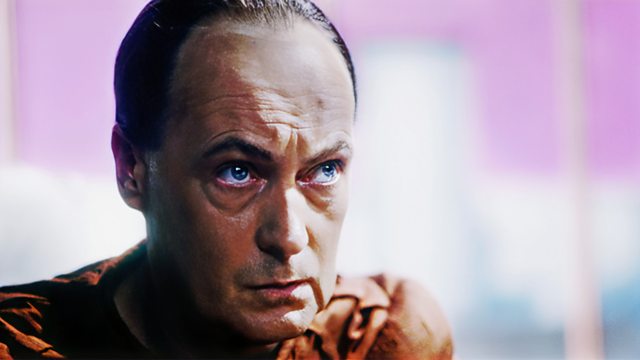
Everybody puts in a good performance in this story. I must start with Christopher Gable, playing Sharaz Jek, who puts in a really memorable performance as the central villain, who does have a tragic background, even if he is a bit creepy in his intentions towards Peri. His movements are very considered and he is suitably threatening, especially in his treatment of the Doctor when he is trying to find out what has happened to Peri. Equally, John Normington is very good as Morgus, who truly holds the power on Androzani Major and is wonderfully slimy and despicable. His reactions to the deaths of copper miners in his mine and cutting their mourning period down from a minute to 30 seconds makes him into a truly pantomime villain, and it is a delight to see his downfall after he also assassinates the president. All of the guest characters are morally grey, which makes this story all the more challenging for the Doctor as he does not have any obvious allies, but Chellak and Salateen, played by Martin Cochrane and Robert Glenister, who are stuck in a seemingly unwinnable war.
I am telling the truth. I keep telling the truth. Why is it no-one believes me?
The Fifth Doctor
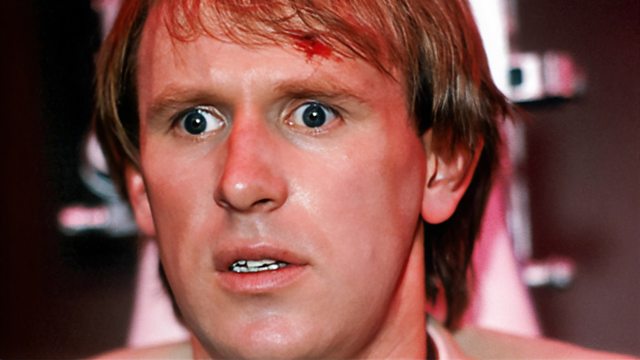
This is Peter Davison’s final story, and it is nice to see him given a great story to bow out on. Whilst his performance has never dropped, some of the stories in his era have not been great, but this caps off a strong season of the show. This story throws everything at the Doctor and his new companion Peri, and there are no easy escapes in this story following both characters being poisoned through coming into contact with raw spectrox. Davison’s Doctor does everything he can to protect Peri, stepping between Jek and her at every opportunity that he has, and it is a sign of his undeniable loyalty to his friends that he is sticking by this fledgling companion quite so soon. At the time of writing, I have not listened to much of the Big Finish audio plays with Peri and the Fifth Doctor to see if it feels as though they diminish him sacrificing himself for someone he barely knows. Nonetheless, Davison puts in a great performance as he signs over the role, portraying the Doctor’s resilience and helplessness when appropriate. He and Nicola Bryant spend very little time together in this story, and Peri does not have a lot to do except for acting unwell in this story, but I think that Bryant does a decent job of what she is asked to do here.
Change, my dear, and it seems not a moment too soon.
The Sixth Doctor
It’s important to address this regeneration from the Fifth Doctor to the Sixth, as it is quite innovative in many ways. Viewed through a modern lens, the Sixth Doctor sitting up and speaking doesn’t feel unusual, but it is important to note that in none of the four previous regenerations had this happened. Nowadays, the new incarnation does tend to get something to say, ranging from a brief exclamation of surprise (the Fourteenth Doctor in The Power of the Doctor) to featuring alongside their predecessor for the closing ten minutes of the episode (the Fifteenth Doctor in The Giggle). Colin Baker also sees his name appear before his predecessor’s in the credits along with his face appearing in the closing titles. The change feels rather abrupt, as does the new Doctor’s sneering attitude towards Peri. Gone is the gentle and well-meaning Davison, and here is Baker’s coarse Doctor, one who is here to continue to develop the gritty and downright nasty tone that the script editor seems to be determined to pursue.
Verdict: The Caves of Androzani is not only a great episode, but possibly the strongest regeneration story in the show’s history. 10/10
Cast: Peter Davison (The Doctor), Nicola Bryant (Peri Brown), Christopher Gable (Sharaz Jek), John Normington (Morgus), Robert Glenister (Salateen), Maurice Roeves (Stotz), Martin Cochrane (Chellak), Roy Holder (Krelper), Barbara Kinghorn (Timmin), David Neal (President), Ian Staples (Soldier), Anthony Ainley (The Master), Matthew Waterhouse (Adric), Sarah Sutton (Nyssa), Janet Fielding (Tegan Jovanka), Mark Strickson (Turlough), Gerald Flood (Voice of Kamelion) & Colin Baker (The Doctor).
Writer: Robert Holmes
Director: Graeme Harper
Producer: John Nathan-Turner
Composer: Roger Limb
Parts: 4
Original Broadcast Dates: 8th – 16th March 1984
Behind the Scenes
- This story had a working title of Chain Reaction.
- The first story to carry a directorial credit for Graeme Harper.
- This is the first regeneration story to end on the new Doctor’s first words, rather than waiting until their first full story to hear them speak. This would become common practice following the show’s revival in 2005.
- The only regeneration story that was written by Robert Holmes.
- Colin Baker is credited first in Part Four of this story, which marks the second time that this has happened to Peter Davison in a regeneration story, as he was second-billed after Tom Baker in Logopolis.
- Eric Saward wrote two scenes; the explanation as to why the Doctor wore celery and the Sixth Doctor’s first scene.
- The regeneration cameos were included at the insistence of John Nathan-Turner, who liked the use of archive footage in the Fourth Doctor’s regeneration. Special contracts had to be drawn up for both Matthew Waterhouse and Sarah Sutton, as neither appeared in Season 21. Nyssa’s creator, Johnny Byrne, also received a royalty payment for her appearance in this story.
Cast Notes
- John Normington would go on to play Trevor Sigma in The Happiness Patrol.
- Robert Glenister played Aboresh in the Big Finish play Absolution and Thomas Edison in Nikola Tesla’s Night of Terror, making him one of a handful of actors to appear in Classic, Modern and Big Finish Doctor Who stories.
Best Moment
It has to be the cliffhanger at the end of Part 3, which sees the Doctor prepared to crash Stotz’s spaceship into Androzani Minor to save Peri.
Best Quote
I might regenerate. Feels different this time.
The Fifth Doctor
Previous Fifth Doctor story: Planet of Fire
For more Fifth Doctor reviews, click here.

 The Impossible Blog
At a time when the sci-fi universe, thanks to filmmakers like Ridley Scott and James Cameron, could afford the more dark-and-gritty aspects, it was understandable that the classic Doctor Who was no exception. In Season 21 it was most evident how unavoidable it could be with The Caves Of Androzani proving how the best could be made of it. For a creepy villain like Sharaz Jek who under the circumstances can be the only guest character (aside from the doomed President) to feel any genuine sympathy for, Christopher Gable’s performance was another reassurance of how an excellent actor can make such a story fairly watchable. I enjoyed this one for the action and thrills, naturally enough being in my mid teens. Nowadays I admire it even more for establishing the Whoniverse as a realistic good-vs-evil universe even in the fantastical way that predominates the franchise in this century. Thank you for your review.
LikeLiked by 2 people
Caves is definitely an example of how Doctor Who could do gritty sci-fi well. Davison sticks out like a sore thumb as a good man surrounded by those covered in shades of grey, and it is one of his best performances.
I have no problem with Doctor Who moving with the times, but I feel like Eric Saward wasn’t the person to oversee it. Season 22 bears that out.
LikeLiked by 1 person
I thought that Eric Saward did his best and certainly at first with The Visitation and Earthshock. Season 22 was a sure sign that a very serious line needed to be drawn between what to beef up and what to tone down. He may have had a specific and somewhat justified sense of how violence should be permitted in Doctor Who. As stories for the 80s with the returns of the Daleks, Cybermen and Sontarans proved, some intensified good-vs-evil dramas could win points as with Captain Kirk facing Khan and the Klingons again in the Star Trek movies.
In retrospect and in my 50s, not everything in Doctor Who appeals to me as much nowadays as it did when I was younger, same with Star Trek, which can be quite a surprise. But consequently our more mature perspectives benefit our reviews.
LikeLiked by 2 people