Oh, look! Rocks!
The Fourth Doctor
Synopsis
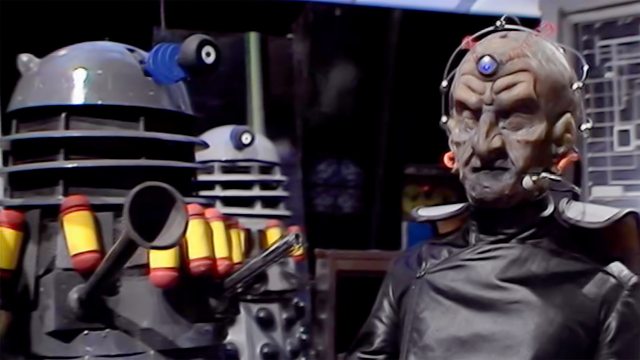
The TARDIS lands on the old Dalek homeworld of Skaro where the Doctor and the newly regenerated Romana discover that someone is digging deep beneath the planet’s surface.
Review
Destiny of the Daleks is a Doctor Who story whose reputation certainly precedes it. When a story like this had a bad reputation, it does make me dread watching it, however, perhaps in this situation, I found that I enjoyed it more than I expected.
That’s not to say that it’s a good or well-written story. The Terry Nation gimmick is definitely getting old by this point, to the extent that it’s almost funny when the Daleks burst through the wall to confront Romana at the end of Episode 1. Nation’s reliance on this trope feels inevitable, as does the reveal that they are in fact on Skaro. There are some ideas that are good, such returning to Skaro years after the events of Genesis of the Daleks as the Daleks seek out their creator in order to help them defeat an equally logical opponent in the shape of the Movellans. It is, however, abundantly clear that Terry Nation and Douglas Adams have completely different approaches to writing. I’ve always found Nation’s writing to be extremely formulaic, and when it is contrasted with Douglas Adams’ more humorous approach, it does really stand out. Adams’ might not be everybody’s cup of tea, but, as he was my entry point into science fiction through The Hitchhiker’s Guide to the Galaxy, I’ve always had a bit of a soft spot for his writing. The story is not helped by the budget, with some bits of set and dressing looking particularly cheap, especially the rocks that block access to the TARDIS in the quarry. There are good moments of direction though, especially with the low shots of the Daleks and the Doctor strolling around the city. There is a lot of padding, however, and a lot of characters being trapped and escaping with ease. That’s a flaw that could be levelled at a lot of Doctor Who in general, but where the writing is poor, it is certainly easier to pick up on.
I created the Daleks. It is I who will guide their destiny. I am the Supreme Commander!
Davros
David Gooderson has probably got a bit of a raw deal here as Davros. Cast to replace the unavailable Michael Wisher, who originated the role and saddled with the same mask, as there wasn’t the budget to make a new one, which results in making him look like a Muppet who has just been hit in the mouth – they always scrunch up their mouths. That aside, I think that Gooderson does a decent job, and perhaps gets lost between Wisher and Terry Molloy, who would play the role from the character’s next appearance until the end of the original run, and then play the role for Big Finish to the present day. The Daleks seek out their creator in order to try and get past their impasse with the Movellans, and to reprogramme their computers to find a way of winning this war. It’s certainly something I question the wisdom of, given that Davros’ downfall is in sending all but one Dalek out to try and blow up the Movellan spacecraft, meaning that the Doctor is able to sneak into the control centre with relative ease. In his absence from the scene, the Supreme Dalek has elevated to a position that Davros feels that he deserves as their creator, and there are already signs of the Dalek Civil War that would go on to provide the backdrop for the three remaining Dalek stories of the show’s original run.
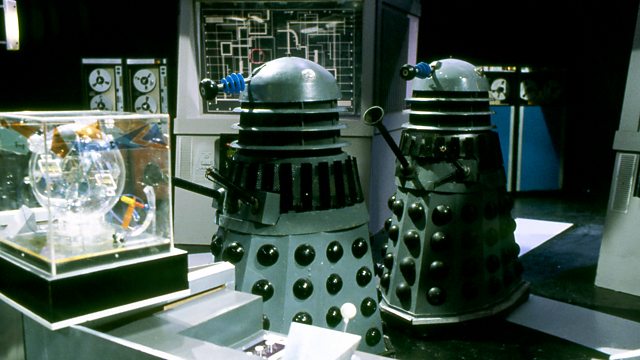
The stalemate sees the Daleks crawl back to their creator, having outgrown him at the end of Genesis, requiring his genius to try and find a way forward. There is an argument that having Davros in stories with his creation weakens the Daleks, and I think that’s certainly true of Destiny. Whilst they do make an impact with their inevitable entrance in the first episode, they don’t really do very much of note here. Davros is the focus here, and the story sees the Doctor openly mock their perceived weakness. Their opponents in this story are the Movellans. There is something wonderfully 1970s about the Movellans, with their jump suits and silver hair. I do like the idea of a Dalek-Movellan war – again, it hints at a wider universe existing outside of the Doctor’s influence. The Movellans are a bit rubbish – you would think that they would have sought to have removed the vulnerability of their battery packs on their belts, where they can be early taken off them. I suppose the Daleks might not be able to manipulate their plungers to remove them effectively here.
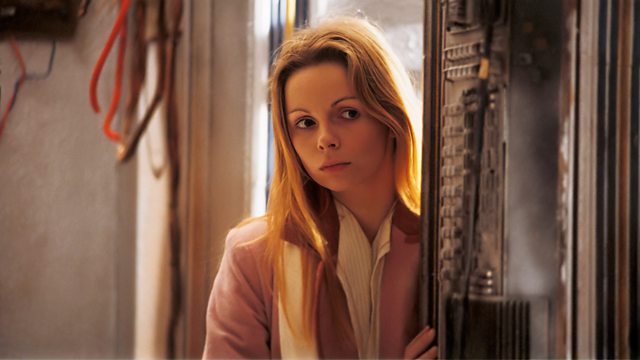
This is a notable story for being the first to feature the second incarnation of Romana, played by Lalla Ward. The regeneration which kicks off this story is intriguing for being seemingly through choice, and taking the form of another character, namely Princess Astra from the previous story. This is quite significant in terms of Time Lord lore – why is Romana seemingly able to regenerate at will without a mortal injury? It does seem to be a simple way of getting around Mary Tamm departing the series. Lalla Ward does not have a lot to do in this story, and perhaps the opening scene is a way of making up for this. Romana is there to be captured and escape, although she does rely on her own wits rather than waiting for the Doctor to save her, especially when she is in the Dalek labour mine.
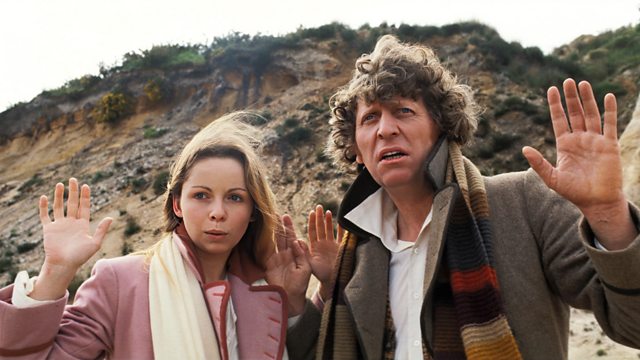
If you’re supposed to be the superior race in the galaxy, why don’t you try climbing after us?
The Fourth Doctor
The introduction of Douglas Adams as script editor sees the Graham Williams era take a more comedic tone, and Tom Baker does rise to the challenge admirably whilst maintaining his authority and sense of otherworldliness. Baker shines in the scenes with Davros, and whilst you can sense that he was probably very difficult to work with around this time, it doesn’t really show through in his performance. I suppose it remains to be seen as to whether the Doctor refusing to take things too seriously damages the show, but I think that Baker has shown that he has the chops to pull this off.
Verdict: Destiny of the Daleks might not be the best Doctor Who story, but it is not as bad as its reputation would suggest. 6/10
Cast: Tom Baker (The Doctor), Lalla Ward (Romana), Tim Barlow (Tyssan), Peter Straker (Commander Sharrel), David Gooderson (Davros), Suzanne Danielle (Agella), Tony Osoba (Lan), Cassandra (Movellan Guard), Penny Casdagli (Jall), David Yip (Veldan), Cy Town & Mike Mungarvan (Dalek Operators) and Roy Skelton (Dalek Voices).
Writer: Terry Nation
Director: Ken Grieve
Producer: Graham Williams
Composer: Dudley Simpson
Parts: 4
Original Broadcast Dates: 1 – 22 September 1979
Behind the Scenes
- The last televised story written by Terry Nation, however, it was heavily rewritten by incoming script editor Douglas Adams. Nation was unhappy with the rewrites.
- The Davros mask used for this story was the same one used by Michael Wisher, as the budget would not stretch to making a new mask for David Gooderson. The mask was in such a state of disrepair that a cleaner threw it away, but was able to be rescued.
- The only story since The Green Death where each segment is labelled as being an episode rather than a part.
- The Dalek cases were in poor condition due to spending four years in storage. This meant having to use bits of original Daleks.
Cast Notes
- Tony Osoba would go on to appear in Kracauer in Dragonfire and Duke in Kill the Moon.
- David Yip also appeared in the Big Finish audio play The Girl Who Never Was.
Best Moment
Probably all the Daleks exploding at the end of the story – it looks like that was quite a lot of fun to film!
Best Quote
Davros! You don’t look a day older, and I’d hoped you were dead.
Dead? I do not die! Mark this moment, Doctor. In this history of the universe, this moment is unique. Davros lives!
Yes, well, I can see your long rest hasn’t done anything to cure your meglomania. Have a jelly baby.
The Fourth Doctor and Davros
Previous Fourth Doctor review: The Armageddon Factor
For more Fourth Doctor reviews, click here.


For a story that could allow Davros to become a recurring villain, even with much better stories ahead with Terry Molloy and Julian Bleach in the role, I remember being quite excited by the Part 2 cliffhanger for this one. Getting to know Lalla as Romana 2 was worth it too. Even if trying to find her original foothold here may have felt a bit convoluted, from her already being a match for Tom Baker’s Doctor Who to her fear of the Daleks, and then to her courage and strength in taking on a robotic Movellan in a physical fight, I was impressed by how well she could build on what Mary Tamm started. Certainly for being the best equal to Tom Baker that she would naturally have to be.
For most Doctor Who stories that fans can feel free enough to enjoy for their own personal reasons, I can still like Destiny Of The Daleks after all these years. That may continue to be one of this show’s blessings even in its most questionable stages today. Thanks for your review.
LikeLiked by 2 people
Thanks for your comment. I definitely found that Destiny does not deserve its reputation. Perhaps that’s because the Dalek story before it is Genesis, but I think that it is definitely unfair!
LikeLiked by 1 person
With the exception of the Daleks being called robots which they’re not, I think that the story via the Daleks/Movellans war had a worthy message on how unconditional logic can be a trap. Hence our making room for other traits like instinct and intuition. With logic still playing a vital role, illogic as a strategy against adversity can be a logic all its own. It’s worked in science fiction before.
LikeLiked by 2 people
Re: the Daleks I’d written that in my notes but forgot about that when it came to write the review!
I also confused this story with Resurrection at first, as I kept expecting the Daleks and Movellans to be talking about the Movellan virus! Whilst I had watched Destiny before, it clearly didn’t make much of an impression on me.
LikeLiked by 1 person