Make your last move, Doctor. Make your last move.
The First Doctor
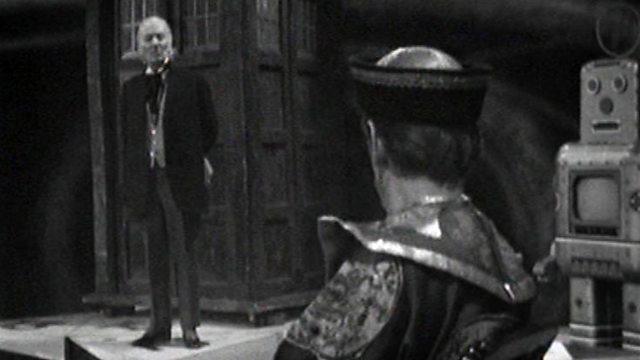
Synopsis
The travellers arrive in a strange domain presided over by the Celestial Toymaker — an enigmatic, immortal entity who forces them to play a series of games, failure at which will render them his playthings for all eternity.
Review
The last 12 months have been pretty big for the Toymaker. In November last year, the villain returned to our screens in the third and final 60th Anniversary special, The Giggle, whilst in 2024, we have had Matroyshka, a Big Finish story featuring Annette Badland, which was recorded in 2020. Then, we’ve had the animation, which has attracted a lot of online discourse.
In preparing this review, I watched the new animation and listened to the original soundtrack with linking narration from Peter Purves. The animation style does take some getting used to, however, I adapted quite quickly and almost stopped noticing it by the end of the first part. It allows for a greater sense of scale to be given to the story, whether that is just making the Toyroom feel vast, which would not have been the case for a studio-bound story in the 1960s, or Michael Gough’s Toymaker looming over the action. The animation style works well for this story as it is one that takes a rather different spin on the usual rules. The crowning achievement of the animation is the Hearts Cards, who move at a different frame rate to all the rest of the characters, making their movements more jerkier and memorable. I genuinely could not find fault with the animation.
I wish that I could say the same for the story, which is distinctly messy. It should be applauded for trying to do something new, by introducing a new powerful foe in the shape of the Toymaker, which is definitely a step in the right direction, even if the costume design is questionable, even without viewing it with a modern viewpoint. Fundamentally, the problem with the story is that it is not that entertaining to watch people play games, especially when the middle two episodes do not feature an identifiable game to start with. There is little new ground being covered here, as the Toymaker’s creations continually get called out for cheating.
The story doesn’t feel as though it serves any of its characters well. The Doctor is invisible for the majority of the story, as a result of production’s attempt to recast their leading man, and then rendered mute by the Toymaker. As a result, it doesn’t really feel as though Michael Gough has much to do as he doesn’t spend much time bouncing off Hartnell. Gough is suitably menacing and it was interesting to see him play a villain, having mainly being familiar with him as Alfred in the Batman films. Dodo is also poorly served by this story, mainly reduced to screaming or generally commentating on proceedings. It is a shame, as I know that Dodo is only with the Doctor for a short time, and I don’t think that any of the stories she has been in so far have truly let her shine. None of the roles of the Toymaker’s creations stand out because of the performances either, and Joey and Clara are particularly irritating.
Verdict: The ambition of the story is good, but ultimately the story isn’t particularly good. Gough is good, and the new animation helps rather than hinders the story. 2/10
Cast: William Hartnell (The Doctor), Peter Purves (Steven Taylor), Jackie Lane (Dodo Chaplet), Michael Gough (The Toymaker), Campbell Singer (Joey the Clown/King of Hearts/Sergeant Rugg), Carmen Silvera (Clara the Clown/Queen of Hearts/Mrs. Wiggs), Peter Stephens (Cyril/Kitchen Boy/Knave of Hearts), Reg Lever (Joker), Beryl Braham, Ann Harrison & Delia Lindon (Dancers).
Writer: Brian Hayles
Director: Bill Sellars
Producer: Innes Lloyd
Composer: Dudley Simpson
Parts: 4 (The Celestial Toyroom, The Hall of Dolls, The Dancing Floor & The Final Test).
Broadcast Dates: 2nd April – 23 April 1966
Behind the Scenes
- The story had the working titles of The Trilogic Game and The Toymaker.
- Donald Tosh did rewrites on the story as the original scriptwriter was unavailable. Tosh agreed with Brian Hayles that the former would have the writer’s credit with the latter having a credit for the idea. When Gerry Davis took over as script editor, he had to make changes due to a budget shortfall, which led to Tosh refusing to be credited. This all meant that Hayles received a credit for a story that he had not worked on for three months and had been changed significantly from his original story.
- During production of this story, it was mooted that when the Doctor disappeared in this story, he would return played by a different actor, in effect recasting the role.
- The Toymaker was meant to return in The Nightmare Fair, when he would have been played by Michael Gough, however, this story was not produced due to the show being placed on hiatus. The Toymaker has subsequently been portrayed by Neil Patrick Harris on television and David Bailie and Annette Badland for Big Finish.
- The story features two racial slurs, in the recitation of the eenie, meeny, miny, moe rhyme, and the title, in which the word ‘celestial’ can be used as a slur to refer to the Chinese.
Cast Notes
- Michael Gough would go on to play Hedin in Arc of Infinity. He was also approached to reprise his role as the Toymaker for the televised version of The Nightmare Fair.
- Carmen Silvera would go on to play Ruth in Invasion of the Dinosaurs.
Best Moment
The first appearance of Cyril did make me jump, which was enjoyable.
Best Quote
I’m bored. I love to play games but there’s no-one to play against. The beings who call here have no minds, and so they become my toys. But you will become my perpetual opponent. We shall play endless games together, your brain against mine
The Toymaker
Previous First Doctor review: The Ark
For more First Doctor reviews, click here.

 The Impossible Blog
Interesting to reflect on classic Doctor Who stories, whether they were particularly successful or not, when the villains of those stories like the Toymaker make great returns after so long. Michael Gough was a sure sign of how a great actor playing such a role to keep the story afloat for the audience. Since this was near the time that Trelane would make his mark in Star Trek, the SF notions of such mischievous entities finding their purpose in just playing devious games with the heroes were becoming popular. And for an SF show like Doctor Who which allows us the most abundant freedom to subjectively enjoy what we wish, perhaps The Celestial Toymaker earns its fair share in that regard and especially thanks to the 60th Anniversary for the Whoniverse. Thank you for your review.
LikeLiked by 2 people
Gough was a really strong piece of casting – like you say, his performance makes the idea of the character more acceptable to the audience.
The Celestial Toymaker shows the show at it’s most experimental and testing what the audience would accept in terms of foes for the Doctor. He’s one of those science fiction (or comic book characters) that is probably best used sparingly – they have the capacity to throw any rule books out of the window. Used too often, they can have the tendency to grate.
LikeLiked by 1 person
I think that’s why the least recurring villains of the Whoniverse tend to stand out somewhat better like the Toymaker and Sutekh. For all the complications that shows with such longevities can suffer, the dichotomies between the old days of the franchise and these days are so easily discussable.
LikeLiked by 2 people