I say; what a wonderful butler, he’s so violent!
The Fourth Doctor
Synopsis
While on holiday in Paris, the Doctor and Romana experience a time distortion. At the Louvre, someone is taking an unusual amount of interest in the Mona Lisa.
Quick Facts
| Doctor | Fourth (Tom Baker) | Parts | 4 |
| Companion | Romana II (Lalla Ward) | Music | Dudley Simpson |
| Writer | David Agnew (Douglas Adams and Graham Williams) | Original Broadcast Dates | 29 September – 20 October 1979 |
| Director | Michael Hayes | Producer | Graham Williams |
Cast
| Julian Glover (Count), Catherine Schell (Countess), Tom Chadbon (Duggan), David Graham (Kerensky), Kevin Flood (Hermann), Pamela Stirling (Louvre Guide), Peter Halliday (Soldier) & John Cleese and Eleanor Bron (Art Gallery Visitors). |
Review
Those who have followed the blog for a little while will know that I am a big fan of Douglas Adams. So it will come as no surprise to hear that I adore City of Death. It is, in my opinion, the high point of Graham Williams’ tenure as producer.
My dear, I don’t think he’s as stupid he seems.
My dear, nobody could be as stupid as he seems.
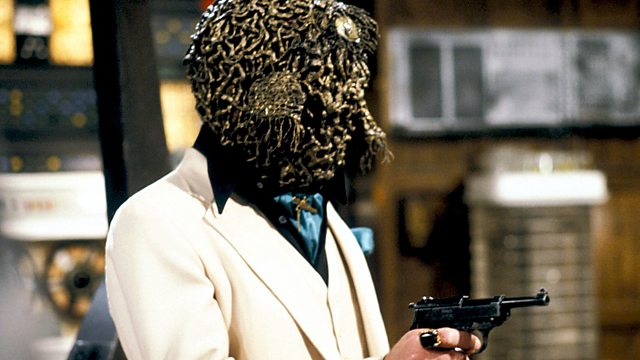
The Countess Scarlioni and Count Scarlioni
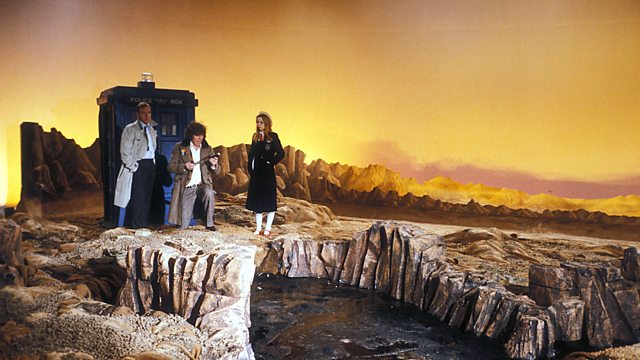
City of Death tells a really compelling and funny story, which uses time travel as an important part of the narrative. We have a series of suspicious activity in the art world as originals of famous artworks have entered the market, sold by the Count and Countess Scarlioni, a villain splintered across time and a potentially world-ending event. The location filming in Paris gives the story a gorgeous backdrop, even if it is a whistle stop tour of the landmarks, from the Eiffel Tower to the Louvre, via Notre Dame. We also time travel with the Doctor to Renaissance Italy, and to the birth of life on Earth. The location filming in Paris feels almost like guerilla filming, especially with shots through postcard stands, but grounds the story in 1979. There are few more iconic shots than the Fourth Doctor running around Paris with Romana and Duggan trailing in his wake, backed by a very memorable score by Dudley Simpson. The story takes it’s time in Part One, setting up mysteries to be solved later, but culminates in a great cliffhanger when it is revealed that Count Scarlioni is in fact a green-headed alien that we saw at the beginning of the story.
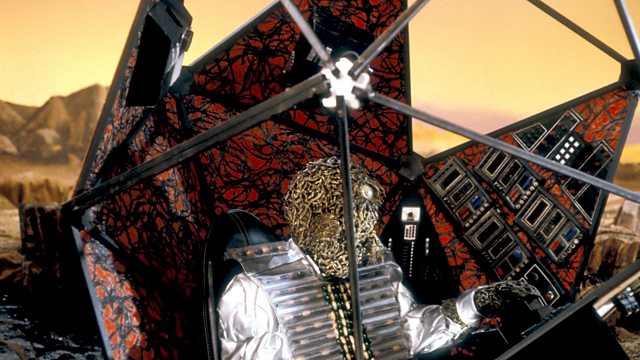
As the story is essentially a caper, villains are required and City of Death has two of the best. Making their living by selling multiple copies of prominent artwork. This story concerns the Mona Lisa, a famous painting by Leonardo Da Vinci, but we are told by Duggan that there have been more before and the Doctor finds the original manuscript for Hamlet, along with copies. The Jagaroth Scaroth has splintered into twelve parts across the course of human history, with one of the parts being Count Scarlioni. He is played by Julian Glover, who brings this aristocrat to life really convincingly. He is silky and charming, and Glover is well equipped to bring that to the screen, knowing where the line is to make his character believable. Glover also has to play Captain Tancredi, Scaroth’s splinter in 16th Century Italy, wielding thumbscrews. It’s a good performance, based on a good idea. Scaroth states that he has been guiding humanity’s development from the wheel and the Pyramids, which is a really interesting concept. His relationship with the Countess seems to be based on subterfuge and her desire for wealth, as she is not aware of his true identity or his ultimate aims. There’s a great conversation between the Countess and the Doctor where she realises how much she doesn’t know about the Count or what he is up to in the basement. It’s a good performance by Catherine Schell, who has a cool indifference to much he Count is doing, standing back as Hermann, their trusty henchman, kills two of their goons. He is the butler who is so wonderfully violent, but he also gets to have fun when the Count tells him to try and sell a Gutenberg Bible discretely. Along with Hermann, the Count has Professor Kerensky doing work on time travel to ensure that he can get back to his ship and have any hope of saving his race. Kerensky is perhaps the weak link in City of Death: he doesn’t have much of a character and it is a poor performance from David Graham, who overacts massively, Perhaps that’s due to the accent the character is forced to adopt, but it is a blemish on an otherwise strong episode.
You should go into partnership with a glazier. You’d have a truly symbiotic relationship.
What?
I’m just pointing out that you break a lot of glass.
You can’t make an omlette without breaking eggs.
If you wanted an omlette, I’d expect to find a pile of broken crockery, a cooker in flames and an unconscious chef.
Romana II and Duggan
This story gives us the first, and sadly only, appearance of Duggan, who is investigating the art fraud that the Count and Countess are doing. Duggan prefers to punch first and ask questions later, which leads to some amusing situations, such as when he threatens to throw a priceless Louis XV chair. Duggan is well played by Tom Chadbon, who passed away earlier this year, and reminded me a lot of Harry Sullivan. He is well-intentioned, but perhaps a bit too blustering to be a full-time companion for the Doctor. It’s a shame that we never got to see him again, and I was quite surprised that Big Finish didn’t attempt to bring the character back.
This is the second story to feature Lalla Ward’s incarnation of Romana, and her chemistry with Tom Baker is off the charts here. Romana and the Doctor are perpetual outsiders, so they are more susceptible to noticing the cracks in time in the café in Part One, but it is undeniably what was going on off-screen that feeds into that relationship. This was the start of a relationship that would lead to a short marriage, Having Romana be a Time Lady makes it fun to have her be impressed (or not) by Earth culture, and whilst the character is undoubtedly academically cleverer than the Doctor, there are still gaps in her knowledge. That allows the two to still have a traditional Doctor and companion relationship, albeit with a twist. It also highlights the Doctor’s fondness for humanity and his eagerness to teach Romana about his favourite species. Ward has good chemistry with Tom Chadbon, which makes their scenes together good fun. Romana clearly thinks that Duggan is an imbecile, and Douglas Adams and Graham Williams give them some great exchanges, like the one above, to demonstrate that. In fact, Lalla Ward takes the script and really makes it shine.
Is no-one interested in history?!?
The Fourth Doctor
Speaking of making Adams’ dialogue shine, this is clearly the most fun that Tom Baker has had in years playing the role. Not only getting to romp around Paris, he gets a lot of the best lines. I could easily fill a blog post with all of the best lines, for instance, how he hates being tortured by someone with cold hands. The majority of the cast play the story rather straight, which gives Baker licence to really hit the comedy beats, including that John Cleese and Eleanor Bron cameo in the Louvre. Baker feels like he is positively fizzing with energy here, bouncing off everybody brilliantly. Even though we don’t get to meet Da Vinci on screen, we get a sense of the Doctor’s relationship with him by the way the Doctor talks about him. It’s the same when it comes to Shakespeare, and how the Doctor recognises his handwriting, stating that the playwright had sprained his wrist writing sonnets. I like the fact that the Doctor is trying to get the Count and Countess to underestimate him, something which they see right through. I have a feeling that this might be one of the last times we get to see Baker enjoy himself in the role before his departure in the following series. It almost feels like he’s recaptured some of his old spark here.
Verdict: The pinnacle of the Graham Williams era, City of Death is a great story. Well written and directed, the cast’s performances elevate this to an all-time classic. 10/10.
Behind the Scenes
- This story marks the first time that Doctor Who filmed overseas. It was originally planned for the story to be filmed in studio, but unit manager John Nathan-Turner (who would go on to become the show’s producer) pointed out that it would be cheaper to go to Paris and film the scenes there.
- Working titles for this story included The Curse of Sephiroth, A Gamble with Time and The Time of the Sephiroth.
- This story was originally to be written by David Fisher, however, he was not able to execute the requested rewrites due to going through a divorce. Fisher gave his blessing to the story being rewritten however the production team wanted.
- Due to a strike at ITV during broadcast, City of Death got extremely high ratings. Part 4 got the highest ratings with 16.1 million viewers.
Cast Notes
| Julian Glover previously played Richard the Lionheart in the First Doctor serial The Crusade. |
| Tom Chadbon would go on to play Merdeen in The Mysterious Planet, as well as appearing in The Paradox Planet and Legacy of Death opposite Tom Baker, and No More Lies opposite Paul McGann. |
| David Graham had previously played Charlie in The Gunfighters. |
| Peter Halliday had appeared in The Invasion with Patrick Troughton, Doctor Who and the Silurians, The Ambassadors of Death and Carnival of Monsters with Jon Pertwee and Remembrance of the Daleks with Sylvester McCoy. |
| Eleanor Bron would go on to appear in the Sixth Doctor serial Revelation of the Daleks, playing Kara. She also played Ileana in Loups-Garoux opposite Peter Davison. |
Best Moment
There are so many in City of Death. I think I must give kudos to the cliffhangers in this story though, especially the one at the end of Part One, revealing that Count Scarlioni is Scaroth.
Best Quote
Doctor, how very nice to see you again. Seems like only 474 years since we last met.
Indeed, indeed, yes. I so much prefer the weather in the early part of the 16th Century, don’t you?
Count Scarlioni and the Fourth Doctor
Previous Fourth Doctor review: Destiny of the Daleks
For more Fourth Doctor reviews, click here.


